
A vending machine display is read in passing, in glare, from above, below and the side, which is a harder optical job than a phone screen on a desk. A 0.77-inch monochrome OLED with a 128x64 resolution and an SPI interface, specified as all-view, is a good fit precisely because its emissive behaviour and wide viewing cone keep the readout legible when the customer is not standing square in front of it. The relevant questions are not about peak brightness alone but about contrast and viewing angle, because those decide whether the price and the selection actually register in the moment.
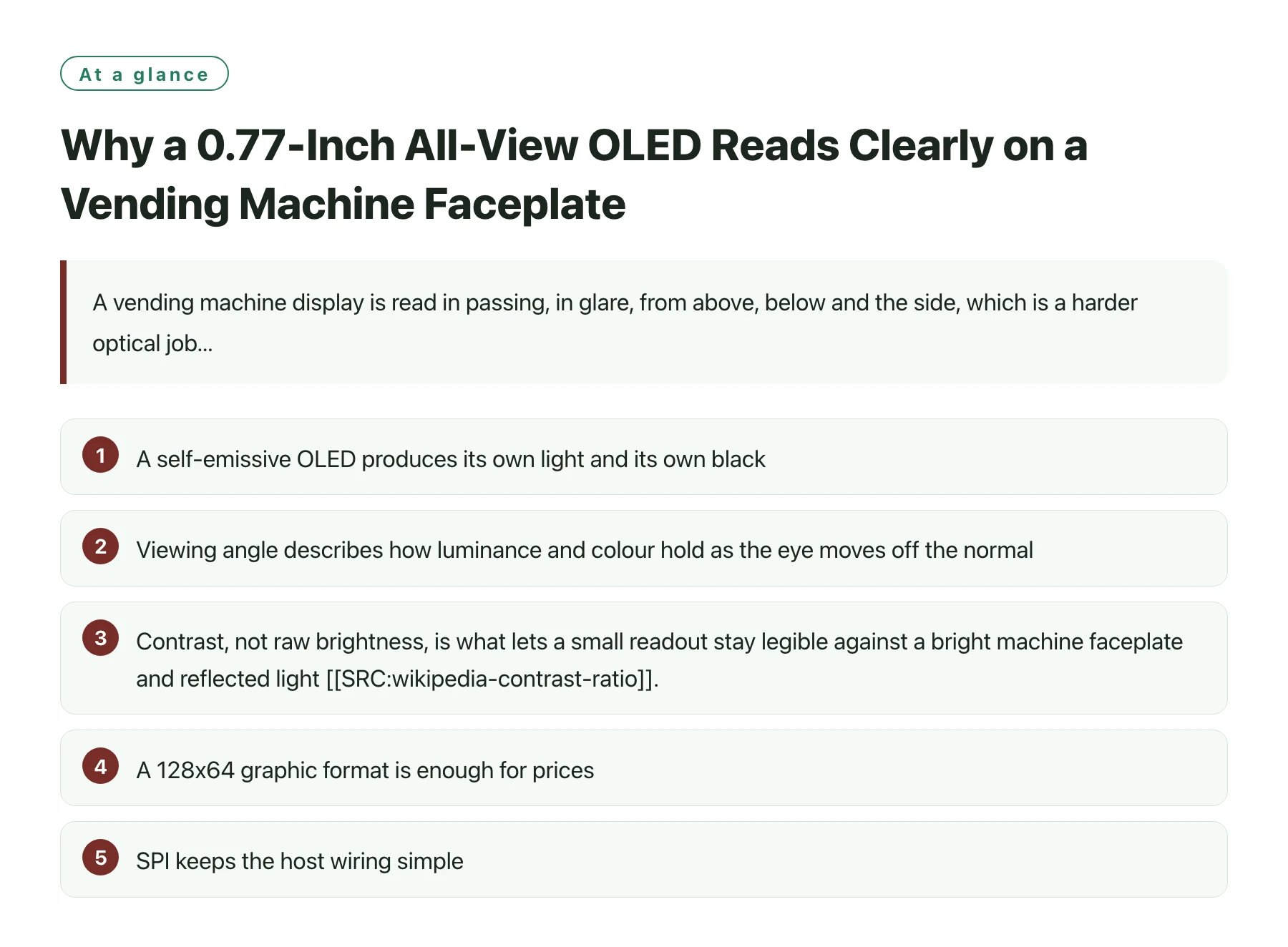
Key takeaways
- A self-emissive OLED produces its own light and its own black, so contrast is set by the panel rather than by blocking a backlight [1].
- Viewing angle describes how luminance and colour hold as the eye moves off the normal, and an all-view part is specified to keep the image readable across a wide cone [3].
- Contrast, not raw brightness, is what lets a small readout stay legible against a bright machine faceplate and reflected light [2].
- A 128x64 graphic format is enough for prices, slot numbers and simple icons, which is most of what a vending UI needs to communicate.
- SPI keeps the host wiring simple, which matters on a dispersed fleet of machines where serviceability beats raw interface speed.
The display on a vending machine is not a centre of attention; it is a glance target. A customer approaches at an angle, in whatever light the location provides, and needs to read a price or a selection in a second or two. That use model rewards a panel that stays readable off-axis and in reflected light more than one that wins a spec-sheet brightness contest.
A small monochrome OLED suits this because it is emissive and typically specified for a wide viewing cone. The all-view attribute means the contrast and the text do not collapse as the viewer moves away from the centre, which is exactly the condition on a real machine. The 128x64 resolution is modest, but a vending UI is mostly text and icons, not photographs.
The rest of this article separates the optical claims that matter in the field from the ones that look good on paper, and explains why a simple SPI interface is a feature rather than a compromise for a deployed fleet.
Contrast is the real readability metric
On a bright machine faceplate the enemy of legibility is not darkness but the reflected and ambient light that washes over the readout. A backlit display fights that by pushing more light through a filter, while an emissive OLED simply does not emit in its dark areas, so the text stays distinct against the lit segments.
This is why the all-view and contrast behaviour matter more than a peak-brightness number for this application. A bright but low-contrast readout can still vanish in glare, whereas a high-contrast emissive readout keeps the characters separable from the background even when the surrounding light is strong.
Designing the UI to exploit this helps: high fill for the active glyphs, generous spacing and avoiding fine detail that the eye cannot resolve at a glance. The panel gives you the contrast; the layout decides whether the customer can parse it in a second.
What the vending environment demands of the panel
| Field condition | Effect on readout | Why the OLED trait helps |
|---|---|---|
| Glancing angle | Off-axis dimming on narrow panels | All-view cone keeps text readable |
| Reflected light | Washes out low contrast | Emissive black preserves separation |
| Mixed lighting | Changes apparent brightness | Self-lit pixels need no backlight balance |
| Quick glance | No time to refocus | High contrast aids instant parsing |
Why SPI is enough here
A 128x64 monochrome graphic display does not need a high-bandwidth interface. SPI carries the commands and the bitmap comfortably, and it lets a simple controller or microcontroller drive the panel with few lines and well-understood software.
On a fleet of vending machines, serviceability and part commonality matter more than interface speed. A display that any field technician can bring up with a standard SPI routine is cheaper to maintain than one that demands a specific high-speed bridge.
For engineers comparing options, the 0.77" SPI OLED display module pairs this SPI interface with an I2C alternative on the same footprint, which gives layout flexibility without committing the whole design to one bus.
Specify the vending display by its viewing cone and contrast behaviour under reflected light, not by a brightness number in a dark room. That is the condition the customer actually experiences.
Sources
Frequently asked questions
Is 128x64 enough for a vending UI?
For prices, slot numbers and simple icons it is ample. The limitation is detail, not communication; a well-spaced text and icon layout reads faster than a higher-resolution panel crammed with small text.
Why does viewing angle matter more than brightness here?
Customers read the machine from angles and in glare. An all-view emissive panel keeps contrast across that cone, whereas a brighter narrow-cone panel can dim or wash out exactly when it is glanced at sideways.
Does the OLED need a backlight?
No. It is self-emissive, so it generates both the lit and the dark states itself. That is what preserves contrast under reflected light and removes a backlight failure mode.
Why choose SPI over a faster interface?
The resolution does not require high bandwidth, and SPI keeps the host simple and serviceable across a fleet. I2C as an alternative on the same part adds layout flexibility without cost.